Measure the surface. Set the thickness. Estimate cans. Floor area, wall area and ceiling area are different measurements. Use the manufacturer-reported DealMart yield of 20 board feet per can to turn the measured volume into a planning estimate.
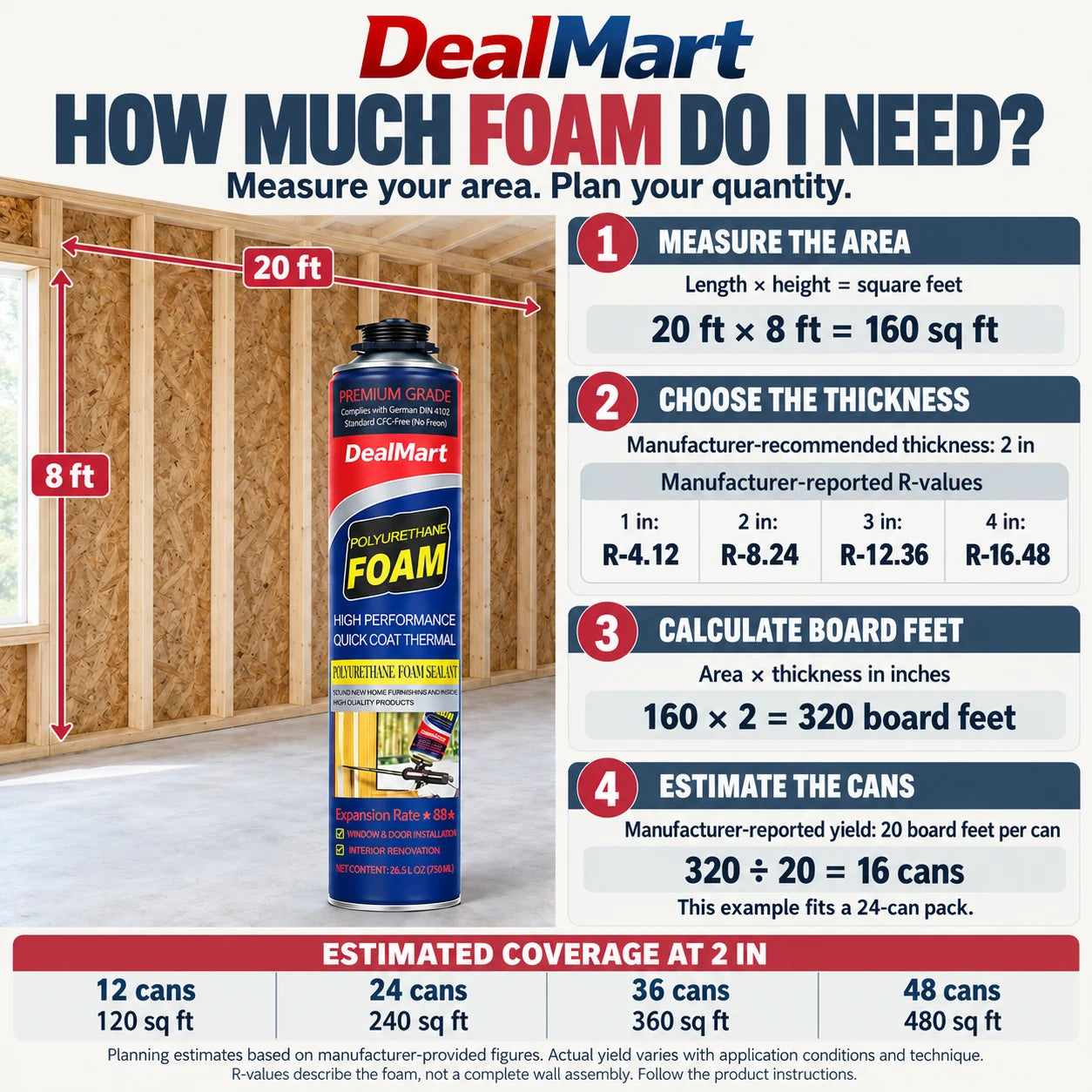
Manufacturer-reported yield: 20 board feet per can. At the recommended 2-inch thickness, this equals approximately 10 sq ft per can. Estimate volume as area in sq ft × thickness in inches, divide by 20, then round the can count up.
MEASURE FIRST
PLAN YOUR ROOM & KIT QUANTITY.
For a rectangular room with four walls and an optional flat ceiling. Enter measurements in feet. For sloped ceilings or irregular spaces, measure each surface separately.
More than 48 cans: combine packs or request a wholesale quote.
Planning estimate at 20 board feet per can. Can counts and 12-can cases round up; no fixed waste allowance is added. Actual yield varies. Confirm product suitability and allow for your job conditions before ordering.
A 10 × 20 ft room: a worked example
Assume a rectangular room 10 ft wide and 20 ft long, with 10 ft high walls and a flat ceiling. These dimensions are an arithmetic example, not an application recommendation.
| Surface | Calculation | Area |
|---|---|---|
| Four walls | 2 × (10 + 20) × 10 | 600 sq ft |
| Flat ceiling | 10 × 20 | 200 sq ft |
| Walls + ceiling | 600 + 200 | 800 sq ft |
Subtract openings that will not be sprayed. For example, 60 sq ft of wall openings reduces the wall area to 540 sq ft and the combined area to 740 sq ft. A 20 × 20 ft room with 10 ft walls is a different example: 800 sq ft of walls + 400 sq ft of ceiling = 1,200 sq ft before openings.
Area and thickness answer different questions
Square feet describe surface area. Board feet describe volume: board feet = square feet × thickness in inches. One square foot at one inch thick is one board foot. For a single-wall arithmetic example, 20 ft × 8 ft = 160 sq ft; multiplying by an example thickness of 2 inches gives 320 board feet. For DealMart’s manufacturer-reported 20 board feet per can, 320 ÷ 20 = 16 cans. The next available single pack is 24 cans. The manufacturer recommends 2-inch foam thickness; follow the layer instructions.
How do I turn area into a can quantity?
Manufacturer-reported yield: 20 board feet per can. At the recommended 2-inch thickness, this equals approximately 10 sq ft per can. Estimate volume as area in sq ft × thickness in inches, divide by 20, then round the can count up.
| Pack | Volume | Estimated area |
|---|---|---|
| 12 cans | 240 board feet | 120 sq ft |
| 24 cans | 480 board feet | 240 sq ft |
| 36 cans | 720 board feet | 360 sq ft |
| 48 cans | 960 board feet | 480 sq ft |
Manufacturer-reported thermal values
| Foam thickness | Reported R-value |
|---|---|
| 1 in | R-4.12 |
| 2 in | R-8.24 |
| 3 in | R-12.36 |
| 4 in | R-16.48 |
Manufacturer-reported planning figures, confirmed for DealMart. Actual yield varies with application conditions and technique. R-values describe the foam, not a complete wall or roof assembly. The R-value table is not a single-pass spraying instruction, fire-rating claim or building-code approval.
Which nozzle is for ceiling work?
The straight and 45° angled tips both attach to the applicator gun. The angled tip directs spray upward for suitable overhead applications. It changes direction, not the foam’s documented yield. See the two red nozzle types.
What comes with each pack?
12, 24, 36 and 48-can packs contain 1, 2, 3 and 4 cases. Each case includes 6 nozzle pairs — 6 straight tips plus 6 angled tips — and the other listed accessories. Compare the complete kit quantities or request a business quote.